Colony Flow level 478 walkthrough: monkey with its tongue out
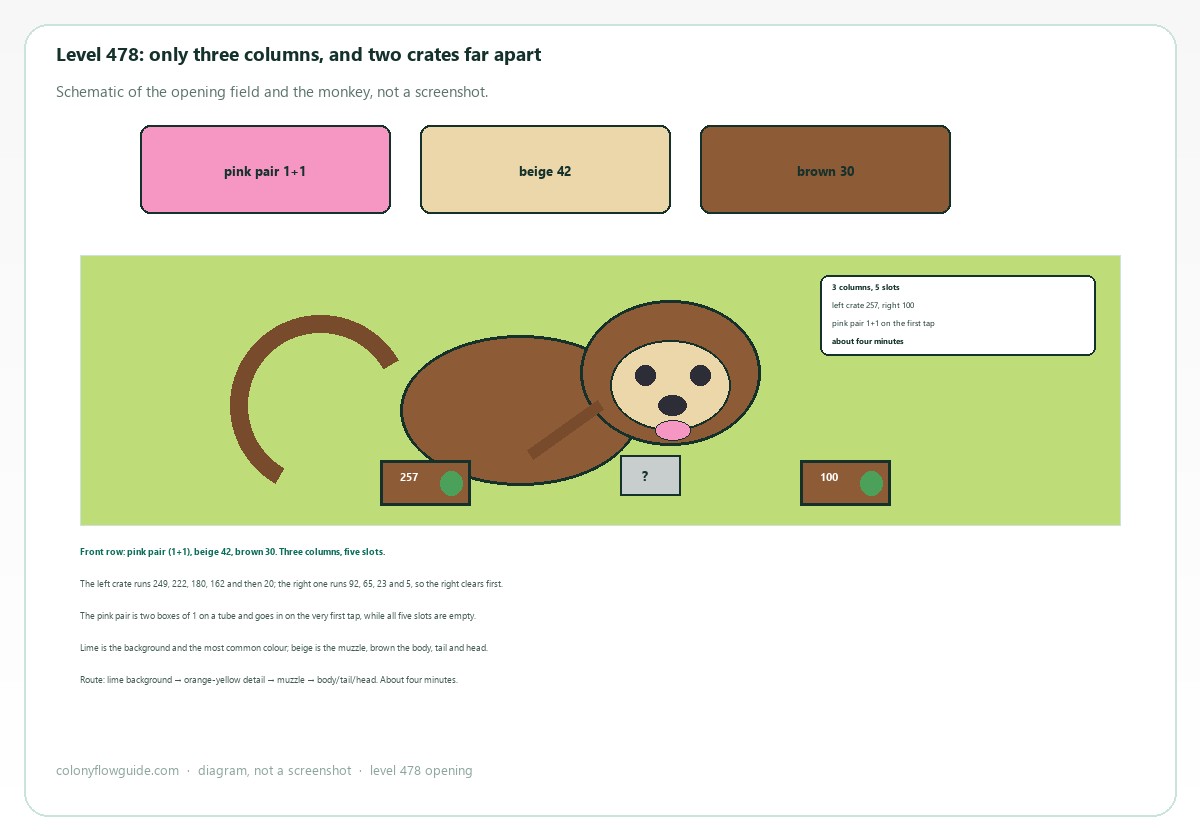
Level 478 is a Normal board of about four minutes: a brown monkey with a long curled tail, a beige muzzle, dark eyes and a pink tongue, on a lime background, with a yellow-orange detail at the lower right. Three columns feed five slots. The front row is a pink pair of 1+1, beige 42 and brown 30. The left crate starts at 257 and the right crate at 100. They do not finish together.
Send the pink 1+1 pair while all five slots are empty. Then lime, starting with lime 33, and yellow 31 with yellow 28 for the lower-right detail. The left crate is the limit: 257, 249, 222, 180, 162, 20, 0. The right crate is 100, 92, 65, 23, 5 and is gone before the head. Beige 42 waits until the muzzle is on the edge. Brown 30 waits until the body and the outside of the tail are actually being eaten. Open the question mark in column 2 only with two slots free.
That order is the whole level. Three columns cannot refill a five-slot tray quickly, so a box that is not on an open edge is a lost slot. The five-slot rule is the one the store listings describe: tap a box into a slot, the ants carry matching blocks, and a row of slots with nothing left to reach stops the colony.
Check this is your board
Use this page only if the opening matches. The picture is a brown monkey, tail curled out to the left, beige muzzle, dark eyes, pink tongue, lime background, and a yellow-orange piece sticking out at the lower right. The game does not print a name under the picture, so match the tongue and the two crates, not a title.
Labelled opening, not a raw screenshot. Confirm the front row against the first seconds of the video before you copy a later tap.
Stop if the picture differs
This route is the build 1.1.46 board checked on 16 November 2026: two crates, 257 on the left and 100 on the right, pink 1+1 in the front row, three columns. A public upload from the same day describes a different 478, a monkey on a meadow with a banana under one crate, opening on light green 35 and running about sixteen minutes. If that is what you see, the counters on this page will not move the way you expect. Match the picture after any store update. The sourcing note is how a mismatch gets corrected.
Level 478 at a glance
Fact
Reading
Field
3 columns, 5 slots, slots empty at the start
Front row
Pink pair 1+1, beige 42, brown 30
Left crate
257, then 249, 222, 180, 162, 20, 0
Right crate
100, then 92, 65, 23, 5, then gone
Paired readings
222 with 65, then 180 with 23, then 162 with 5
Hidden
Question mark, low in column 2, colour unnamed until it is loaded
Clear
About four minutes, no booster, on the 5 August 2026 playthrough
The crates are counted covers: the number falls only while ants eat open cubes beside the glass. That rule is on the counted-crate page. The pair takes two slots on one tap, which is the linked-pair rule. The question mark follows the hidden-box rule. Having all three on one narrow field is the case the combination note is about.
Boxes the clear actually names
These are the boxes written down at each tray reading. They are not a guess at every buried stack. Where a column position is not in the clear, it is not filled in here.
Box
When it is recorded
What it is for
Pink pair, 1 and 1
Front row, first tap
Two slots, small pink edge, including the tongue
Beige 42
Front row, held
Muzzle, and only after lime has peeled it
Brown 30
Front row, held
Body and tail once that edge is wide, then the head
Lime 33
From the depth, just after the pair
Background from below and the right
Yellow 31 and yellow 28
Both in the one-third tray
The lower-right yellow-orange detail
Black-blue 24, dark pink 19, pink 1
Same one-third tray, which is full
Small edge details. This full tray is working, not jammed
Lime 7, beige 15, pink 1, yellow 21
Middle tray, one slot free
Last upper background, open muzzle, tongue. Hold yellow 21 if the corner is gone
Six readings, in order. Slot contents are what was sitting in the tray at that point. Crate pairs are the two counters at the same moment. This is the logged clear, not a slogan repeated six times.
Pink pair, slots empty
All five slots are empty. Both crates are shut: 257 on the left, 100 on the right. Send the pink pair. It occupies two slots and the pink edge is small, so both slots come back almost at once. Leave beige 42 where it is. Leave brown 30 where it is. A little brown on the outer edge of the body can already be showing; that is not enough cubes for a 30. Lime 33, from deeper in the columns, is the next box into the tray, and it starts the background from below.
Lime background and the yellow corner
Lime peels the field from the outside inward, under the monkey and along the right. Yellow 31 and yellow 28 take the lower-right detail while it is open. By one third of the clear the tray reads black-blue 24, dark pink 19, yellow 31, pink 1, yellow 28. All five places are taken, and each box is working, because its colour is on the edge. The crates read 222 and 65. Do not pull a beige box out of the depth here. The muzzle is still half covered.
Muzzle, with the right crate nearly done
At the middle, a lot of the upper and right background is gone and the monkey is mostly exposed. Lime remains on the left and around the head. The tray has one free slot, then lime 7, beige 15, pink 1 and yellow 21. The crates read 180 and 23. Beige 15 is legal now: the muzzle edge is wide. Pink 1 takes the tongue and the small pink pixels. If the yellow-orange corner is already gone, yellow 21 has nothing to eat. Hold it. Do not empty every lime box in one burst. Some background is still holding the left crate, and a tray full of idle boxes freezes that counter. The right crate is about to disappear. You do not wait for it.
Body, tail, and the hidden box
Just after the middle the right counter passes 5 and the crate leaves the picture. The tray reads black-blue 23, beige 23, yellow 15, pink 1 and yellow 21. The left crate is on 162. Brown now takes the flanks of the body and the outside of the curled tail, working inward along the curl. Keep at least one box in the tray whose colour is on the current edge, or the chain stops and both counters stop with it. The question mark in column 2 can come forward in this stretch. Load it only while two slots are free. Its colour is not named in the clear, so the spare slot is the plan.
Head, ears, and the drop from 162 to 20
What is left of the picture is the brown contour of the head and ears. Body, tail, muzzle and the open background are gone. The right crate is already gone. The left counter falls from 162 to 20 on this wave, because the last lime around the head goes with it. The tray reads black-blue 19, lime 20, lime 20, beige 34 and dark pink 15. The two lime 20s take the islands left between the ears. Beige 34 finishes the muzzle along the contour. Black-blue 19 and dark pink 15 take the eyes, the nose and the inner ear. Brown leaves in the last waves, for the crust of the head. Keep one lime in the field until those ear gaps are actually open. Do not put more than two boxes of the same colour in the tray at once. The second one waits, and on a three-column board a waiting box is the jam.
Last cubes
Brown clears the last of the head and ears. The left crate, still showing 20, finishes on that lime-and-brown wave and is the later of the two crates. The pair is long gone. The question mark has been opened and worked. The last two lime cubes are eaten when the slots are already empty. If a box’s last cubes are hidden behind another colour, send the outer colour, wait for the slot, then take the inner one. Nothing about the ending is fast. It is only empty.
Four-minute pace
Phase
Time
What “on pace” looks like
Pink pair
0–0.4 min
Pair in, pair out. Beige 42 and brown 30 still in the field. Crates still 257 and 100
Lime and yellow corner
0.4–1.3 min
Tray full of working colours. Crates at 222 and 65
Muzzle
1.3–2.1 min
Beige 15 working. One slot free. Crates at 180 and 23
Body and tail
2.1–3.1 min
Right crate through 5 and gone. Left crate at 162. Brown on the outer tail
Head and ears
3.1–4 min
Left crate drops 162 to 20, then 0. Two lime 20s still have a job
The video linked below has no creator chapters. These bands are the written clear mapped onto the counter readings, so you can pause the picture and see whether you are in the same tray. A box count only earns its slot when it is no bigger than the cubes the ants can already reach. That comparison is the count-versus-cubes check, and it is the same idea as the count-to-cube ratio.
How to know you are behind
Left crate still above 200 at two minutes: lime is behind, and beige or brown went in too early. Right crate still on the board at two and a half minutes: that is late. It should be through 5 and gone once the head’s background is open. A full tray is not automatically a failure. The one-third tray is full on purpose.
Why 257 and 100 are not a pair
Both crates wear the same green ball and neither one takes a slot. That is all they share. The left counter drops 257, 249, 222, 180, 162, 20. The right counter drops 100, 92, 65, 23, 5. The paired moments are the useful part: 222 with 65, 180 with 23, 162 with 5. When the left crate still has 162 to go, the right one is finished or about to be.
The right crate sits where the lime opens first, so the same sends move it further. The left crate sits under the tail side, and the cubes around it come off later. Feed the two as if they were equal and you will still be tending the right one after it has nothing left to teach you, with the left one stuck above 180. Push lime along the left from the first minute. Let the right counter tick in the background for as long as lime is already in the tray.
A covered counter does not fall because time passed. It falls because an open cube next to it was carried off. If the tray clogs, both numbers freeze. That is why a stalled beige 42 looks like a crate bug and is not one. The same split shows up on level 464, where the left crate also refuses to share a pace with the right one, on a four-column field instead of three.
Which colour is actually on the edge
The picture comes off from the outside inward. A colour deserves a slot only while its cubes are on an edge the ants can touch. The same hue later in the picture is a different job. What “reachable” means, cube by cube, is the reachable-edge rule.
Layer
Send
Leave in the field
Opening edge
Pink pair, then lime 33
Beige 42, brown 30
Lower right, first third
Yellow 31, yellow 28, and the small black-blue and dark pink that are already on the edge
Deep beige, a second yellow after the corner is gone
Muzzle, middle
Beige 15, lime 7, pink 1
Yellow 21 if the corner detail is finished
Body and tail
Brown, from the outside of the curl inward, plus whatever lime is still beside the left crate
The question mark, until two slots are free
Head and ears
Lime 20 and lime 20, beige 34, black-blue 19, dark pink 15, then brown
A third box of any one of those colours
Lime is the background, so it is legal early and still legal at the end. That is not one long lime phase. Lime 33 opens the bottom. Lime 7 finishes the upper field. The two lime 20s are a late job, in the gaps between the ears, and two last lime cubes go in after the tray looks empty. Sending every lime the moment it appears is how the middle tray loses the free slot that beige 15 needs.
Yellow is the opposite. It is a short job. Yellow 31 and yellow 28 belong to the corner and then they are done. Yellow 15 and yellow 21 showing up in the later tray are the boxes that become ballast if the corner is already gone. Brown is large and late, with one exception you can see: the tail reaches the left edge, so brown has a real edge before the head does. That edge is the outside of the curl, around the 162 reading. It is not a reason to spend brown 30 on tap one. The front-row 30 is too big for a thin edge.
While the pink pair is still in the field, the practical tray is three slots, not five, because the pair will need two of them together. That is the reserve rule. After the pair has cleared, you get the five slots back, and the one-third reading is allowed to use all five.
If the run is already stuck
The usual mistakes are short. The useful part is what to do after the tray is already wrong. The test is the same one the App Store listing is built around: if the box will not start emptying at once, it does not deserve the last free slot. A restart costs nothing on the clock. The recovery habits for a clogged colony in general are on the strategy page. These are the ones this board actually produces.
Full, and still a clear
Black-blue 24, dark pink 19, yellow 31, pink 1, yellow 28. Five boxes, each colour on the edge, crates moving through 222 and 65. Leave this tray alone.
Full, and stuck
Beige 42 or brown 30 in a slot during the opening, or a question mark in the last slot, or a yellow that is no longer counting down. The crates freeze because nothing beside them is being eaten.
Beige 42 or brown 30 is already in a slot
If you are still in the opening, beige 42 will sit until the muzzle reaches the edge, around the middle reading of lime 7, beige 15, pink 1, yellow 21. Do not “fix” it by loading a second beige. You still have four slots for lime. Pull the beige back only if you are one slot from a jam and the muzzle is still buried. One stalled box is what Pick Up is for. Two stalled boxes are a restart. Brown 30 is the same shape of error, one step later: a thin brown edge on the outline is not the tail phase. Send brown when the outside of the curl is actually coming off, at the 162 reading, not because the box is sitting in the front row looking large.
The tray is full at one third
Check the colours before you treat it as a jam. If they are the five in the good card above, you are on the clear. If one of them is beige, a deep brown, or a yellow whose corner is already gone, that box is the one that should not be there. Take it back or restart, then return to lime until the left crate is coming down through 222. Clearing the muzzle early does not help a crate that is still buried.
A question mark took the last slot
This is the jam the three-column field cannot absorb. The colour was unknown until the box entered the slot, and a colour that is not on the edge will not leave. Send that one box back if you have Pick Up, or restart. The prevention is mechanical: one hidden box, and only while two slots are empty. The tempting moment is the head phase, when lime looks endless. It is not endless. The two lime 20s still have the ear gaps to finish.
The left crate has stopped falling
The counter is not soft-locked. Ants are not eating the cubes next to the glass, which means the tray has no working lime, or the lime that is working is on the wrong side of the picture. Stop the muzzle, even if some beige is showing, and put lime back on the left and the lower edge until the counter moves. If it is still above 200 two minutes in, you are a full phase behind the 222 reading. The right crate being gone does not fix this. It was never the slow one.
Yellow is still sitting after the corner is gone
Yellow 31 and yellow 28 are allowed to fill two slots in the first third, because the detail is open. After that detail is gone, another yellow is a blocked slot with a small number on it. Yellow 21 is the one the middle reading tells you to hold. If it is already in the tray and the counter on the box is not moving, it is the single box worth a Pick Up. Do not load yellow 15 behind it.
Boosters, and when they are a waste
The logged clear does not use one. The four names are the buttons on this guide’s booster page. The store screenshots show the buttons; the coin cost of a spare charge is kept on the coin ledger, not restated here. On a four-minute Normal board, a restart is cheaper than a charge unless the button changes the tray you are in right now.
Button
On this board
Use it
Skip it
Extra Slot
The only charge that changes the shape of 478. Three columns already struggle to refill five slots, and the pair needs two of them at once.
The pair is still in the field and four slots are full of working colours, or the question mark is about to surface with one slot free.
The tray has already jammed on beige, brown or a dead yellow. A sixth slot does not empty a stalled box.
Pick Up
Returns one box from the tray to the field.
Exactly one stalled box: beige 42 before the muzzle, or yellow 21 after the corner.
Two or three stalled boxes. One refund does not open a chain.
Shuffle
Re-deals the colours in the three columns. It cannot create a colour the field does not have.
The front row has no lime and the background is still the open edge. Lime 33 is the box you are trying to find.
You are stalled on a colour that is already in the tray, or you hope the shuffle will reveal the question mark as a convenient colour. It will not.
Vacuum
Clears a patch of one colour from the picture, which is the same work a lime box does beside the glass.
The left crate is frozen well above 180, the tray is otherwise healthy, and a lime patch is the only thing holding the counter.
The tray is the problem. Vacuum does not free a slot. It is also a waste once the counter is already on 20 and lime 20s are in the tray.
Which of those charges is even worth owning on a long board is covered under boards that justify a charge. Level 478 is not one of them if the opening pair went in first.
The level 478 video
The clear this route is checked against is Colony Flow level 478 by SINISTER GAMING WORLD, published 5 August 2026. The same film is the English walkthrough embedded on the Colony Flow Guide write-up of level 478 (published 21 September 2026, updated 23 September 2026), which times it at about four minutes. Watch the opening before you trust a later tap. The front row in that clear is the pink pair, beige 42 and brown 30.
There are no creator chapters on that film. Pause on the tray, not on a timestamp. One third of the way in you want black-blue 24, dark pink 19, yellow 31, pink 1 and yellow 28, with the crates on 222 and 65. At the middle you want one free slot and the crates on 180 and 23. If the opening row is not the pair, you are not on this board.
The six tray readings above are the ones written up beside that film. The Google Play listing, updated 20 November 2026, is the rule under them: tap a box, the ants carry matching blocks, and a full row of slots with nothing left to reach is a loss. ABI GAMES PTE. LTD. publishes that Android listing. ABI GLOBAL LTD. publishes the iOS listing.
Notes from this board
Four notes worth keeping from the same clear. Each one is a reading in the table above, not a second copy of the short answer.
slotwick
A full tray at one third is the clear, not the fail
I burned a restart the first time the fifth slot filled, because three columns had taught me that full means dead. The tray was black-blue 24, dark pink 19, yellow 31, pink 1 and yellow 28, and both crates were still moving, 222 and 65. Those five colours were all on the edge. The restart I actually needed came later, when I added beige to a tray that looked just as full and then nothing moved.
brine_moth
I waited for the right crate and lost the left one
At the middle the right counter was already 23 and the left was 180. I sat on the right crate until it hit 5, and by then the easy lime beside the left crate had been spent on nothing. The next run I only looked at the left number. The right one ticked down whenever lime was already working. It does not need a phase of its own.
NessaKite
Yellow 21 is a hold, and two of a colour is the cap
Yellow 31 and yellow 28 earned their slots because the corner was open. Yellow 21 was still in the tray at the next reading and I sent yellow 15 behind it. Two yellows that are not counting will sit there through the body phase. The same cap shows up at the end: two lime 20s are enough for the ear gaps. A third lime, while beige 34 and black-blue 19 still have work, is how the head stalls with the left crate sitting on 20.
P. Ortega
The question mark is a slot problem, not a colour puzzle
Column 2 hides it low, and the clear never names what it is. I stopped trying to guess. I let it reach the front only when two slots were empty, once the right crate had already gone and brown was on the outside of the tail. When I had opened it into the last slot, the colour was not on the edge and the three columns had nothing ready to replace it. Pick Up saved that one box. It would not have saved three.
Boards with the same kind of counter
478 is the narrow version of a crate problem. Level 464 is the wide one: four columns, crates at 154 and 148, and the left crate finishes first instead of last. Same lesson, opposite pace. The filter for counted crates and the filter for linked pairs list the rest of the recorded boards that share one of those pieces.
23 November 2026: tray readings, the recovery cases, the booster table and the on-page video added to the 16 November check. Counter chain unchanged. If your build no longer shows 257 and 100, say so in the note form. That is the correction we can publish.
Level 478 notes from other players
0 approved notes · read by a moderator before publishing
Approved notes on level 478 load below. Add yours if your build’s front row or crate numbers differ from the checkpoint table.
Quick answers
Level 478 questions
How do you beat Colony Flow level 478?
Send the pink 1+1 pair while all five slots are empty, then lime, starting with lime 33, to peel the background. Yellow 31 and yellow 28 take the lower-right detail. Beige waits until the muzzle is on the edge, and brown 30 waits until the body and the outside of the tail are being eaten. The left crate counts 257, 249, 222, 180, 162, 20, 0 and finishes last. The right crate counts 100, 92, 65, 23, 5 and is gone before the head.
How many columns does level 478 have, and what is in the front row?
Three columns and five slots. The front row is a pink pair of 1+1 joined by a tube, beige 42 and brown 30. A question mark sits low in column 2.
How does the crate at 257 count down?
The published readings are 257, 249, 222, 180, 162, then a drop to 20 and zero. It moves only while ants eat open cubes beside it. At the one-third tray it is on 222, at the middle reading it is on 180, and the drop from 162 to 20 comes when the last lime around the head and ears goes.
Why is the other crate only 100?
The right crate sits where the lime background opens first. Its readings are 100, 92, 65, 23 and 5, and it disappears before the head. At the middle reading the left crate is still on 180 while the right is already on 23, so they are not a matched pair.
When should the pink 1+1 pair be sent?
On the first tap, while all five slots are empty. The pair takes two slots at once and clears on the small pink edge, then both slots come back. With three columns feeding five slots, sending it into a busy tray is the fastest way to stall.
When is beige 42 safe to send?
Not at the start. The muzzle is behind the lime background. Beige 15 is the box in the middle tray, once the edge is open, and beige 34 finishes the muzzle contour near the end, beside black-blue 19 and dark pink 15.
Where is the hidden box, and when should it be opened?
Low in column 2. Its colour stays unknown until it reaches the front. Open it only when at least two slots are free. The published clear does not name the colour it reveals, so plan a spare slot rather than a colour.
Can level 478 be cleared without a booster?
Yes. The logged clear is about four minutes and uses none. Extra Slot is the only charge that changes this board much, and only if the pair or the question mark is about to need a free slot. Pick Up saves one stalled beige or yellow. Shuffle and Vacuum do not fix a tray that is already full of colours off the edge.
What if my level 478 shows a banana under one crate?
Stop. This route is the tongue-out monkey with two crates, 257 on the left and 100 on the right, a pink 1+1 pair, and three columns, checked on build 1.1.46. A single crate hiding a banana, opening on light green 35, is a different picture under the same level number. The counters below will not match it.
Three columns, five slots
The pair needs two of them empty. Everything else on this board is a consequence of that.