Level 396 · Normal
Colony Flow level 396 walkthrough: the 200 tile, then the puppy
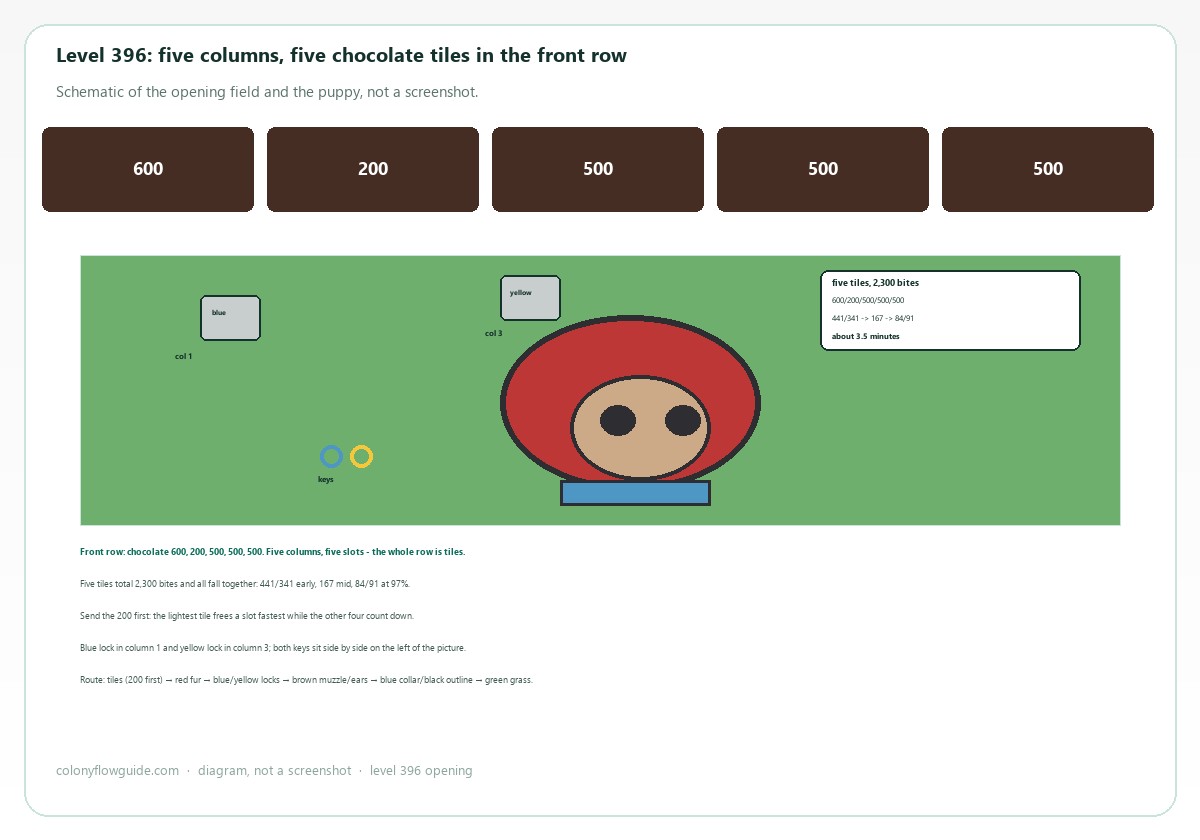
Level 396 is the collared puppy on grass: red fur, a light brown muzzle and ears, a blue collar. Five columns, five slots, and a front row of chocolate. The clear that matches this picture runs about three and a half minutes with no booster.
- Board
- Puppy in a collar on grass
- Difficulty
- Normal
- Slots
- 5, empty at the start
- Columns
- 5
- Front row
- 600 / 200 / 500 / 500 / 500
- Specials
- Two locks, no linked pairs
The answer
Send the 200 chocolate tile first, then the other tiles one at a time, and keep at most two brown boxes in the five slots. The front row is 600, 200, 500, 500 and 500, which is 2,300 bites. A blue lock seals column 1 and a yellow lock seals column 3. Both keys sit together on the left of the puppy, the blue one under chocolate and red fur. Greens sized 41, 42, 29 and 65 come out about a third of the way through and only eat grass, so more than two of them stall the row. The puppy comes off from the outside inward. Grass is last.
What you are looking at
Ants only carry a colour they can already reach. A box whose colour is still buried just occupies a slot, which is the ordinary rule in how to play, and it is the whole difficulty of this board. The picture is buried under a counted cover: five chocolate tiles across the front, one per column.
| Piece | Where | What it changes |
|---|---|---|
| Chocolate 600 | Column 1, front | Heaviest tile. Same brown work as the 500s, longer count |
| Chocolate 200 | Column 2, front | First send. Frees a slot while the others are still counting |
| Chocolate 500 | Columns 3, 4 and 5 | Three equal tiles. They stay paired with the 600 |
| Blue lock | Column 1 | Boxes behind it wait for the blue key |
| Yellow lock | Column 3 | Boxes behind it wait for the yellow key |
| Both keys | Left of the puppy, side by side | Under chocolate, then under red fur. Blue is the more covered of the two |
There is nothing else special on this board. No linked pairs, no hidden box that appears after the clear, no second wave of tiles. The published notes on the level 396 walkthrough are explicit about that, and the embedded clear below matches it: once black 8 leaves, the picture is empty.
Boxes the clear actually puts in the slots
These are the stacks recorded in the slots as that clear progresses, not a guess at every cube still inside the columns. Sizes matter because a 65 with no target holds a slot much longer than a 16 that can finish.
| Point in the clear | What is in reach | Chocolate still showing |
|---|---|---|
| Opening | Five empty slots. Front row only: 600, 200, 500, 500, 500 | All five tiles |
| About one-third | Greens 41, 42, 29 and 65, newly out from behind the tiles | Down from 441 and 341 |
| Middle | Green 30, red 35, black 16, red 35 | One counter at 167 |
| After the middle | Green 24, light blue 18, black 35, red 20. Collar visible | Remnants at 84 |
| Late | Blue 17, light blue 16, black 35, red 13 | None |
| Last boxes | Reds 12 and 28, then blacks 18 and 8 | None |
Read the colours against the picture, not against the slot they happen to sit in. Green is grass, and the grass is the outer rim. Red is fur. Light brown on the muzzle and ears is ordinary brown picture, which brown ants do not touch until a chocolate counter on that path has hit zero. Light blue and blue are the collar and the shadow under the puppy. Black is the outline, especially around the eyes and nose at the end. That split is why a red box and a brown tile are not substitutes for each other.
Why the five counters move together
A chocolate tile is a brown counter lying on the picture. Brown ants eat that counter before they will take ordinary brown cubes underneath. The tiles follow the counted-cover rule: they are not five separate pictures, and they are not buttons you tap for a different colour.
The heavy tiles lose bites at the same pace. Early in the clear the notes show 441 beside 341. That is the same 100-bite gap as 600 versus 500, which is what you see when those four have lost the same amount and the 200 has already been the one you finished. Later, one counter is at 167, then the leftovers are at 84. They arrive at zero together. Holding more than two brown boxes does not make this faster. The slot strategy on a five-tile opening is the opposite: one or two brown boxes in the slots, the rest of the tiles left in the row so a slot stays free.
If one heavy tile is far behind the others, that column is not getting brown work. Catch it up before you spend the free slots on red or green. The 200 is the exception you do rush, because it is the only tile short enough to give a slot back while the other four are still in the hundreds.
Locks, keys, and the left edge
The locks follow the key-and-padlock rule. Column 1 does not move until the blue key is cleared off the picture. Column 3 does not move until the yellow key is cleared. Both keys are on the left of the puppy, next to each other, not in the locked columns. The blue key starts under chocolate and red fur. The yellow key is beside it. As the left edge comes apart their exact position shifts, so look for the key shape on that edge rather than memorising a square.
| Lock | Column | Key | Do not send yet |
|---|---|---|---|
| Blue | 1 | Left edge, the more covered key | A blue box for the collar |
| Yellow | 3 | Left edge, beside the blue key | A yellow box with nothing open to eat |
The muzzle starts to show on that same left edge around the middle, next to where the keys sit. That is the cue that you are in the right part of the picture. A blue box sent for the collar before this point has nothing reachable, and it cannot open the lock by itself.
How to beat level 396
The 200 tile, then the other four
Slots start empty. Send the 200, then one heavy tile at a time. Cap brown at two slots. Leave columns 1 and 3 alone behind the locks. While the tiles are up, the fur and the grass you can see are only the strip above the chocolate, and they are not a target yet.
Let only one or two greens out
About a third of the way in, the columns hand you greens of 41, 42, 29 and 65. The heavy counters are walking down from 441 and 341. Take one green, or two if a slot is genuinely spare, and leave the 65 in the column if you have to choose. It is the longest idle green. If the blue key peeks out on the left, clear it and column 1 opens. Do not go looking for it before the chocolate on that edge is thin.
Use the short black 16 in the middle
The middle snapshot is green 30, red 35, black 16 and another red 35, with one chocolate counter at 167. Black 16 is the pressure valve: it finishes and gives the slot back. Send a red 35 only when the fur edge is actually open. The second red 35 can wait. If the yellow key is already out, open column 3 and keep going. The light brown muzzle is starting on the left, but the red layer over it is still in the way.
Take the collar when it is actually open
Past the middle the snapshot is green 24, light blue 18, black 35 and red 20, and the tile leftovers are at 84. Light blue 18 now has the collar. Red 20 still needs open fur; it is the same idle-slot mistake as an early red 35. Get both locks off if they are not off already. Red works from the edges inward. The light brown muzzle and ears come off after the red covering them, and only once brown ants are done with chocolate.
Work inward, and hold the grass
Chocolate is gone. The notes show blue 17, light blue 16, black 35 and red 13. Blue takes the collar and the shadow under the puppy. The picture order from here is the outline of the back and the paws, then the sides, then the middle of the muzzle. Grass is partly open around the rim, but red pixels are still working, so a green box still waits for a free slot. All five columns can move once the locks are gone.
Finish on the small reds and the last black
Reds 12 and 28 pick up the ears and the tail. Blacks 18 and 8 take the dark line around the eyes and the nose. When the puppy is almost gone and the slots are empty, send every green still in the field. The rim clears quickly. Nothing new arrives after that. The notes treat black 8 as the last box.
Bottom first, then the outside of the dog, then the face, then the rim. Chocolate, red fur, the two keys, light brown muzzle and ears, collar and shadow, last blacks, grass. Grass is last because those pixels sit on the outer edge and only open when the puppy is nearly gone.
If the row is already stuck
The route above is the clean line. These are the four states players actually meet when the row has already gone wrong, and what still helps.
The slots are full of green
Greens 41, 42, 29 and 65 are out, and chocolate is still on the board. Stop taking green. The only useful tap is a box that can bite right now: the next chocolate tile, or later the black 16. If all five slots are already green, the published clear calls that a stall. There is no picture left for those ants to eat. Restart. Spending a booster on a row that cannot bite does not uncover the puppy.
A red box is parked on covered fur
Red 35 and red 20 work only on fur that is already open. If one of them is sitting while chocolate still covers the dog, that slot is lost until the tile in front of the fur finishes. Do not add the second red on top of the first. Finish the chocolate at the fur edge, then the parked red starts to move.
Column 1 or column 3 still will not move
The lock is not in the column you are tapping. Clear the left edge of the picture. Blue is the key under chocolate and red fur, so it is the later of the two. A blue or yellow box sent before its key is out will not open anything, and the collar is not a reason to send blue early.
Every slot is a chocolate tile
Sending all five tiles packs the row. Brown ants cannot finish five long counters at once, and you have no slot left for the black 16 or a single green you might actually need. The recorded cap is two brown boxes. Leave the other tiles in the front row. They keep counting down from the brown work already in the slots.
Pace checks you can see
Use the board, not a sliced minute mark. The clocks on public recordings do not even agree: the English playthrough this route follows is about three and a half minutes, while the levels index files number 396 as a Normal clear of about 3:03 across 61 frames. Confirm the puppy and the front row, then judge yourself against the snapshots.
| If you can see | You are on pace when | You are behind when |
|---|---|---|
| Greens 41, 42, 29, 65 available | Heavy tiles are already down from 441 and 341, and at most two greens are in slots | The heavy tiles are still near 600 and 500, or green is in every slot |
| The middle mix, with black 16 | One chocolate counter is near 167, and red is touching open fur | Red 35 is parked and the fur edge is still chocolate |
| Collar visible, light blue 18 out | Remnants are near 84 and both keys are gone | A lock is still shut, or light blue went in before the collar showed |
| No chocolate left | You are on small reds and the last blacks, grass waiting for a free slot | Green is filling the row while red 13, 12 or 28 still has fur to eat |
Boosters on this board
The recorded clear does not use one. Three stars on a Colony Flow board come from finishing without a booster. On this level the only booster that changes the geometry is Extra Slot, and only while a free slot still exists: one more seat during the five-tile opening, or while those greens of 41 to 65 are trying to climb into the row. A guide to the wider roster is on the boosters page. Public write-ups disagree about coin prices, so this page does not tell you to buy one.
| State | Better move |
|---|---|
| Two brown tiles working, three slots free | No booster. This is the intended opening |
| One free slot, and a long green is about to be the fifth occupied slot | Extra Slot can save the run. Use it before the row locks, not after |
| All five slots green, chocolate still up | Restart. Nothing in those slots can bite |
| A red or blue box is idle on a covered target | Leave it and clear the cover. A shuffle does not uncover the puppy |
That last point is the same warning as the general slot rule: do not fill the final slot unless the box you put there starts emptying at once. It is spelled out in Gaming Route's Colony Flow levels guide, and the green flood on 396 is the case they are describing.
Watch the level 396 clear
This is the English level 396 recording the counters and the slot sizes were checked against: Sangat Gaming, published 31 July 2026. Pause when the slots match a row in the table above. The useful frames are the first appearance of greens 41, 42, 29 and 65, the middle row that contains black 16, the collar becoming a real target for light blue 18, and the last blacks before the grass run.
Open the level 396 walkthrough on YouTube
What keeps coming up on this board
Same sticking points as the recorded clear, written out as the decisions that actually save a slot.
LinaVoss
Once the greens of 41, 42, 29 and 65 are out, I allow myself one of the shorter ones and I leave the 65 in the column. A 65 with grass still covered is the box that turns a manageable row into a stall, and it shows up earlier than the grass does.
OwenPark
Black 16 in the middle is the box I want in a slot. It finishes while a red 35 is still on open fur, and that free slot is how the second red 35 gets in later instead of stacking both reds on top of chocolate.
PriyaNunez
Red 20 is the same trap as red 35, just later. Light blue 18 looks like the collar the moment it appears in the column, but the collar is not a target until you can see it. I wait for the collar, then the 18, and not the other way around.
ChrisDalton
Both keys are on the left of the puppy, blue tucked further under the fur than yellow. I stopped tapping column 1 hoping the lock would notice. The muzzle showing on that left edge is the sign the keys are about to come free.
Boards that behave like this
Level 394 is the nearest cousin already written up here: a red dog as well, but four columns, a lock chain and a single 400 tile, not this five-tile front row. Level 397 uses keys that sit on the picture too. Level 390 is the long edge-to-centre clear in this stretch, not a chocolate lesson.
| Level 394 | Level 396 | |
|---|---|---|
| Picture | Red dog, green collar | Puppy, blue collar, grass |
| Columns | 4 | 5 |
| Counter | One 400 tile | 600, 200, 500, 500, 500 |
| Locks | A lock chain | Blue in column 1, yellow in column 3 |
| Length | About three and a half minutes | About three and a half minutes on this recording |
Level 384 · Hard
Orange cat in dark glasses
Five columns, two pre-filled slots and a 500 tile. About six and a half minutes.
Open level 384Level 387 · Hard
Portrait of a boy in a blue shirt
Three columns, two stacked locks, chest keys. About three and a half minutes.
Open level 387Level 390 · Super Hard
Girl with yellow hair and blue eyes
Five columns, two end locks, a 198 counter and hidden waves. About eleven and a half minutes.
Open level 390Level 394 · Hard
Red dog with a green collar
Four columns, a lock chain, a 400 tile and pink-ball crates. About three and a half minutes.
Open level 394More boards with the same parts sit in the index under counter crates and keys and locks.
Updates move pictures between numbers. PuzzHQ's Colony Flow guide flags that directly. If your front row is not 600, 200, 500, 500 and 500, go back to the level index and match the picture instead of the number. The puppy, the five tiles, the two locks and the slot sizes on this page follow the colony-flow.ru level 396 notes and the Sangat Gaming recording embedded above.
Level 396 notes from other players
0 approved notes · read by a moderator before publishing
Approved notes on level 396 load below. Add yours if the walkthrough above missed the case you hit.
Quick answers
Level 396 questions
How do I start Colony Flow level 396?
Send the 200 chocolate tile first, then the other four one at a time. Keep at most two brown boxes in the five slots. The front row is 600, 200, 500, 500 and 500.
What should I do with the 600 and the 500 tiles?
Send them one by one, not all at once. The counters fall together, so they reach zero at nearly the same time. The recorded snapshots show the heavy tiles at 441 and 341 early, one counter at 167 in the middle, and remnants at 84 after the middle.
Where are the keys on level 396?
The blue key and the yellow key sit side by side on the left of the puppy. The blue one is partly under chocolate and red fur, so it clears later. Column 1 stays locked until the blue key is gone, and column 3 stays locked until the yellow key is gone. The exact spot shifts as that edge comes apart.
Why does level 396 stall on green boxes?
Greens sized 41, 42, 29 and 65 come out from behind the tiles about a third of the way through, but green only clears grass, and the grass stays covered until the puppy is almost gone. Send one or two. Five greens with chocolate still up is a stall.
When do red and light blue have a real target?
Red 35 and red 20 only clear fur that is already open. Light blue 18 belongs on the collar, which shows after the middle. The last outline work is black, including black 18 and black 8 around the eyes and nose.
Can I clear level 396 without a booster?
Yes. The recorded route uses none. Extra Slot only helps while a free slot still exists. A row that is already full of green is a restart.
How long does level 396 take?
The English playthrough this route follows runs about three and a half minutes. A separate index lists number 396 as a Normal clear of about 3:03 across 61 frames. Match the puppy and the front row before you trust either clock.
What if my level 396 is not this puppy?
Updates move pictures between numbers. If the front row is not chocolate 600, 200, 500, 500 and 500, with a blue lock in column 1 and a yellow lock in column 3, this is the wrong board.
Row already full of green?
That stall is the 65 sitting too early, not a slow puppy. Restart, open on the 200, and keep brown to two slots.