Level 184 · Hard · build 1.1.46
Colony Flow level 184 walkthrough: clear the eye without a dead slot
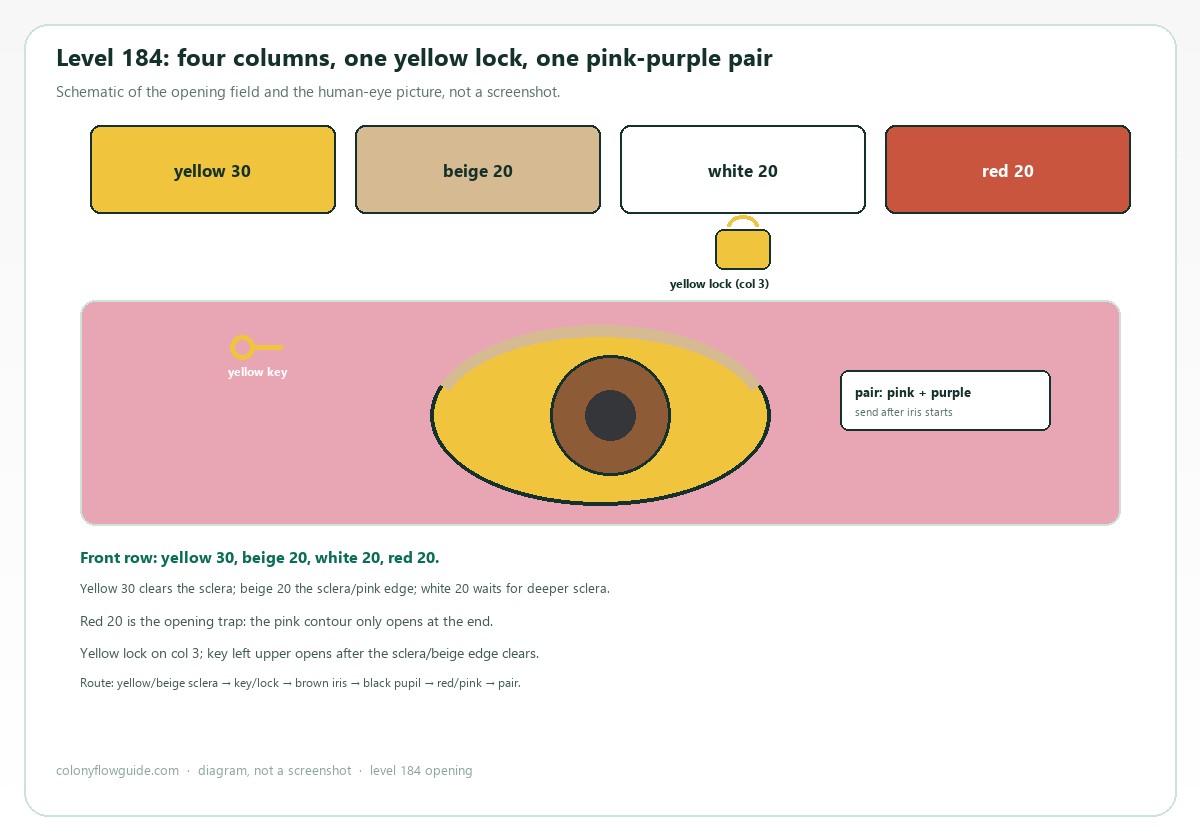
Level 184 is the Hard eye: pink ground, yellow sclera, beige edge, brown iris, black pupil. The field has five columns and five slots. A yellow lock sits on column 3 until the yellow key in the upper-left of the eye is cleared, about halfway through the 4 minute 38 second no-booster clear. The pink + purple pair is the other special, and it only earns two slots after the iris starts to open.
- Board
- Human eye built from cubes
- Difficulty
- Hard
- Slots
- 5
- Columns
- 5, lock on column 3
How to beat level 184
Open with yellow 30 and beige 20. Leave white 20 and red 20 in the field. Stay on yellow and beige until the sclera breaks, then walk brown around the iris and start the pupil with black. About halfway, take the upper-left yellow key and open column 3. Send the pink + purple pair only after that iris is retreating, and spend red on the pink contour last.
The number on a box is the ant count, not a layer. Yellow 30 holds its slot until all 30 ants finish; a black 6 from a deeper row leaves much faster. The how to play page covers the march itself. ABI's own listing states the failure this board is built around: “Open a color that has nothing left to carry and that slot stays clogged. Fill all five and your colony grinds to a halt.” (Colony Flow! on Google Play, ABI GAMES PTE. LTD.)
-
Yellow and beige on the sclera
Send yellow 30 and beige 20. Yellow works the sclera in a ring; thirty ants is the longest opening counter, so that slot is busy on purpose. Beige clears the edge between the sclera and the pink ground, which is also the path toward the key. White 20 and red 20 stay in the tray. White belongs to the deeper sclera. Red belongs to the final pink contour.
-
Yellow gaps, with the pair still in the field
Keep the next yellow and beige boxes coming. Near the one-third mark of the 4:38 clear, a slot line can already read beige 7, red 1, purple 3. Beige 7 still has edge work, and red 1 is almost done, so let that short red finish. Purple 3 means a purple box was sent early. Do not follow it with the pink half. The key is still under sclera at this point, and column 3 is still not a full column.
-
Brown iris, lock still shut
Once the yellow disk breaks, send brown in rings from the outer iris toward the pupil. Black 6 can start the dark center; its counter is short. Around this hand the boxes available include black 6, beige 13, white 20 and red 15. Send brown and beige. White only if the deeper sclera is actually open. Red 15 is the same trap as red 20, just later: the pink contour is still closed. The lock on column 3 can now be seen, and it still does not move. Leave the pair where it is.
-
Yellow key, then the box behind column 3
About halfway, the last cubes around the upper-left key come off. The key leaves the picture and takes the yellow lock with it. The box that was behind the lock joins the front row; send it only if its color matches an edge that is already open. On the filmed line the slots are down to purple 2 here, which means purple was used early and has nearly finished. Fill what you just freed with the short black counters from deeper in the columns. They cycle fast. This is the first moment column 3 behaves like the other columns.
-
Pink + purple, only once the iris retreats
Send the pair when the iris is actually shrinking, not when two slots merely happen to be empty. Purple still has work on the iris edge. Pink finally has the outer contour. Both halves have somewhere to walk, so the two slots are the right price. If purple is already down to a short counter from earlier, send pink only when that contour is open, not to “finish the pair” while the center is still solid.
-
Red 13, black 3, then the pink frame
In the last minute the slots show red 13 and black 3. Black takes the last pupil fragments. Red, held since the opening, finally has pink contour to carry. After that pair has done its work, what remains is a thin pink frame. Send pink as it reaches the front row. A wrong color here reclogs a slot on a board that is otherwise finished. Held red and held pink make this ending continuous instead of a long pause.
The picture only opens from the outside inward, so the ants need an edge before a color has anything to carry. The key is buried in the sclera layer, which is why column 3 stays a one-box column until halfway. The pair straddles two layers, iris edge and outer contour, so it belongs on the boundary between them.
Five columns, not four front numbers
Counting the opening taps and calling this a four-column board is the mistake that makes the lock feel random. The field is five columns wide. The numbered boxes sitting in the opening row are four: yellow 30, beige 20, white 20 and red 20. Column 3 is the one with the yellow lock, so everything behind that lock is not an opening tap. The pink + purple pair is a tube, not another single numbered front box, and it costs two slots when it moves. Four numbers plus a lock plus a tube is the whole opening. It is not a four-column field.
What the opening row is for
| Opening object | Where it sits | When it has work |
|---|---|---|
| Yellow 30 | Front row | Immediately, on the sclera ring. Longest opening counter. |
| Beige 20 | Front row | Immediately, on the edge between sclera and pink ground. Also the path to the key. |
| White 20 | Front row | After the outer sclera thins. Almost nothing to carry at the first tap. |
| Red 20 | Front row | Last. The pink contour is the final layer. |
| Yellow lock | Column 3 | Blocks every box behind it. The front of that column is all you get until the key. |
| Pink + purple pair | Tube, two slots | After the iris starts to retreat. Not an opening tap. |
Other boards that hide a stack the same way are indexed under keys and locks. The pair rule, including why a tube spends two slots even when only one half can walk, is on the linked-pair note.
Key, lock, and the one pair
The yellow key is in the upper-left of the eye, inside the picture. Yellow and beige uncover it. Tapping column 3 harder does not. Until the key flies to the lock, column 3 contributes its front box and then stops, so for the first half of the clear the field plays narrower than five. The key and padlock note is the general form of this: the key is on the picture side, the lock is on the tray side.
There is one tube on this board, pink joined to purple. Purple can nibble the iris edge once that ring exists. Pink cannot, until the outer contour is the exposed edge. That is the whole pair decision. It is not a second lock, and it is not a stack of tubes.
If your level 184 is not this eye
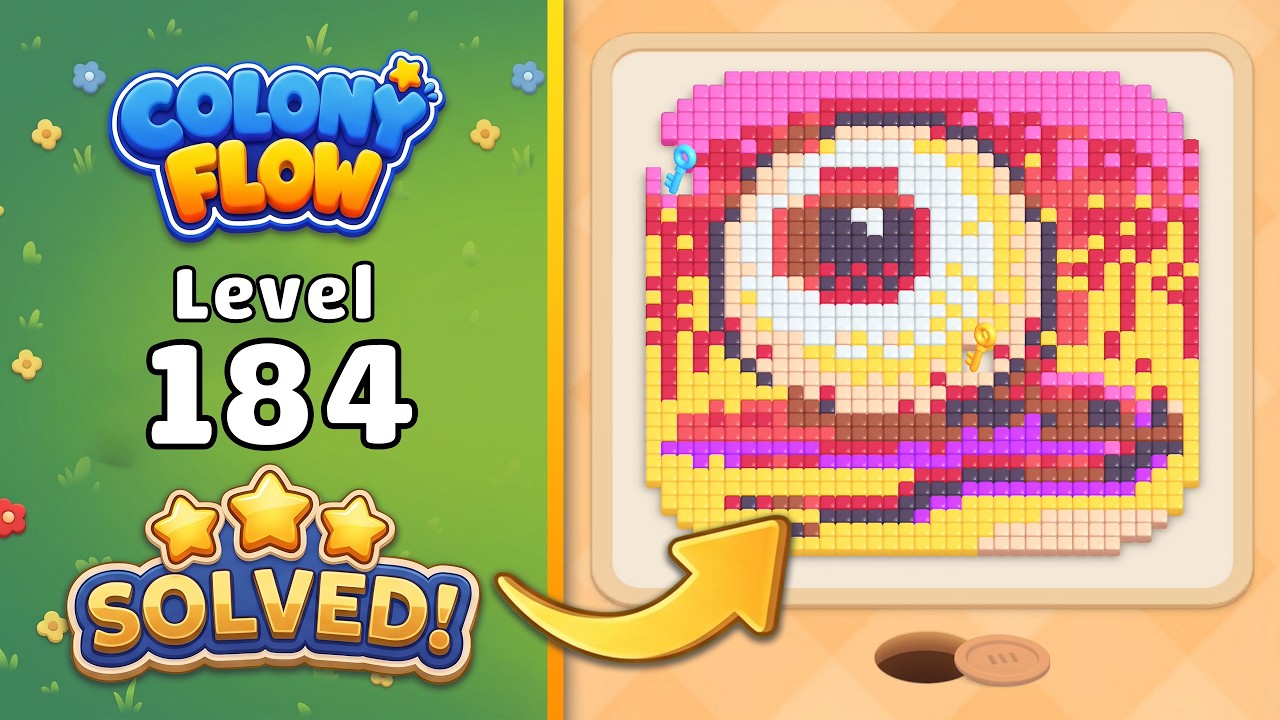
Match the picture, not the number. This route is the Hard eye with the yellow lock on column 3. Other public write-ups filed under “level 184” describe a fried egg on a red packet, or a cyan submarine, and one level index lists 184 as a normal clear of about three minutes and 114 frames. Those are not this board. A 2:08 upload and a 2:24 upload also use the 184 label; the clear this page follows is the 4:38 no-booster recording, and its title card is the eye with a three-star solved mark. If your picture is something else, the index on that install has shifted. Browse the level list by the picture, or update from the current build and check the Hard tag before you spend a booster on the wrong layout.
Checkpoints in the 4:38 clear
Use the counters, not the clock, to see whether the run is still the route. These are the slot states in the no-booster clear, in order.
| Phase | Where it falls in 4:38 | What the slots show | What to do with it |
|---|---|---|---|
| Sclera | Opening | Yellow 30 and beige 20 working. White and red still in the tray. | Do not “use up” the front row. Two of those four numbers are holds. |
| Yellow gaps | About one-third (near 1:33) | Beige 7, red 1, purple 3 | Beige still works. Let red 1 finish. Purple 3 is early; do not add pink. |
| Iris | Around halfway (near 2:19) | Black 6, beige 13, white 20, red 15 available | Send brown and beige. Black 6 may start the pupil. White only if deeper sclera is open. Red stays. |
| Key | Just after halfway (near 2:45) | Down to purple 2 on the filmed line | Take the key. Column 3 opens. Fill with short black counters. Pink still waits if the contour is shut. |
| Contour | Last minute (near 3:38) | Red 13 and black 3 | Black finishes the pupil. Red 13 takes the pink contour. Then pink boxes only. |
The one-third line is the filmed line, not the cleanest line. Purple is already in a slot there. The clear still finishes, because the pink half and a fresh red were not piled on top of it. If your own slots show beige 7 and red 1 with no purple, you are ahead of that film: keep the pair in the field until the iris retreats.
While column 3 is locked
For roughly the first half of the clear, column 3 gives you its front box and then nothing. The other columns have to carry the sclera and the approach to the key. The slot strategy page is the general version: one free slot is worth more than a fifth color that cannot walk.
| If this happens during the lock | Play | Do not play |
|---|---|---|
| Yellow or beige is still on an open edge | Send the next yellow or beige. That is the path to the key. | A brown box, while the iris is still covered by the yellow disk. |
| Yellow and beige are briefly between boxes | Hold the empty slot. The next sclera box is about to arrive. | Red, white, or the pair, used as a placeholder. |
| Column 3's front box matches an open edge | Send that one box. It is legal work. | Tap the same column again expecting the stack. The lock is still there. |
| You can see the lock, and the key is still buried | Go back to the upper-left sclera. | Black, just because the pupil “looks next.” Black 6 is for when the ring has started, not before. |
The locked phase is when the pair does the most damage. Two slots for the tube, one slot if red 20 is already parked, and column 3 not really in play: the board collapses to two working slots. That is the restart described in the next section, and no amount of tidying the open columns fixes it.
If a slot is already clogged
Most searches for this level happen after the wrong box is already in. These are the branches, from still-playable to restart.
| What you already sent | Can it finish? | What to do |
|---|---|---|
| Red 20 in the first taps. Pair still in the field. | Yes, tight. | Leave the red alone. Play the other four slots as the route: yellow, beige, then brown, then black. Red moves by itself in the last minute. Do not also send the pair. |
| Purple only, and it is already a short counter. | Yes. The filmed line is in this state by the key. | Let purple finish. Send pink later, when the contour is open, not now. |
| The full pair out, iris still a solid ring. Red still held. | Only if the other three slots stay on colors that can walk. | You are on three slots until halfway. No white, no red, no extra brown before the disk breaks. One more dead color and you stop. |
| Red 20 and the full pair both out before the iris opens. | No. | Four of five slots are busy, and column 3 is still locked. Restart. A booster that returns one box still leaves you short. |
| All five slots full, counters not falling. | No. | That is the halt ABI describes. Restart. Nothing on this board shuffles a clogged color into a path. |
| Past halfway, lock still closed. | Yes, if the slots are not clogged. | You are late, not dead. The key is still under yellow and beige in the upper-left. Stop feeding the pupil and go back to the sclera. |
Which booster is worth a coin here
This route uses none. The 4:38 clear is recorded with no boosters and no commentary, and its title card shows the three-star solved mark. Finishing clean is the point: the lock is a picture problem, and a booster does not move the key.
Fan guides name four buttons under the board. ABI does not publish those names. The account that actually matches the store art is on Gaming Route's Colony Flow levels guide (checked 23 October 2026): Extra Slot adds a slot, Shuffle rearranges boxes left in the stack, Pick Up sends a box from a slot back to the stack, and the fourth icon is not reliably named. The same page records an App Store reviewer, stuck on level 240, saying most levels pay about 20 coins while the cheapest booster costs 1,200, and a Play reviewer saying boosters are sold in sets of three. One spent tool is many clean clears. The in-game list and the prices live on the boosters and coins page.
| Tool | On this board | When it is wasted |
|---|---|---|
| Extra Slot | Optional, and only once the iris is opening and the pair is ready, so the extra room is used by a color that can walk. | At the start. It does not open column 3, and it does not give red 20 a contour that does not exist yet. |
| Shuffle | Almost never. The key is in the picture. The tray order is not why the lock is shut. | Any time the center is still covered. Rearranging yellow, beige, white and red does not uncover the upper-left. |
| Pick Up | The one recovery, if a single early box (red 20, or one half of the pair) is the only mistake and the other slots are healthy. | When red and the pair are all out. Returning one box leaves three busy slots and a locked column. |
| Restart | Free. Use it in the two “no” rows above. | After the key is taken and the counters are still falling. You are in the legal half of the clear. |
Clear notes
Four write-ups from runs of this eye, kept because each one names a slot state rather than a mood.
MaraEll
At the yellow gaps my slots were beige 7, red 1, purple 3. I almost sent pink to “complete” the pair. Beige 7 was still eating the edge, and red 1 was about to leave by itself. Pink would have sat on a contour that was not there. I let red finish, left pink in the tray, and the purple 3 counted down on its own.
JonahPeck
I spent the first two minutes tapping column 3 because the lock was the obvious obstacle. It gave me one box and then nothing. The key is in the upper-left of the eye, under yellow and beige, so the unlock is a picture clear, not a tray clear. Once I went back to the sclera, the key came off around halfway and the column started behaving.
PriyaNoll
Brown sent while the sclera was still a solid yellow disk did not walk. The iris is a ring, and the ants need that ring exposed. I held brown until the yellow broke, then it peeled inward. Black 6 was the first pupil box that made sense, and only after that ring had started. The later blacks come in with small counters, which is why the post-key stretch feels faster than the opening.
ChrisAdeyemi
First run I sent red 20 immediately and nothing else stupid. It sat there, the other four slots did the route, and red woke up in the last minute. Second run I also sent the pair before the iris opened. Four slots were busy, column 3 was still locked, and the counters stopped. Pick Up would have given one slot back. It would not have given the column back. I restarted, and the clean run matched the 4:38 clear.
Watch the no-booster clear
The recording this route follows is the 4:38 no-booster, no-commentary clear published 25 July 2026. Pause on the slot counts above before you copy a later tap. The title card shows the solved eye and a three-star mark; the description states that no booster was used.
Where to pause
These are the same phases as the route, laid on the 4:38 runtime. They are pause marks, not a frame-logged chapter track. With JavaScript they start the embed; without it they open the watch page at the same second.
- 0:00 Opening. Yellow 30 and beige 20. White 20 and red 20 stay in the tray.
- 1:33 About one-third. Yellow gaps. Look for beige 7, red 1, purple 3, and do not add pink.
- 2:19 About halfway. Iris in rings. The lock on column 3 is visible and still shut.
- 2:45 Just after halfway. Upper-left key, then the box behind column 3. Short black counters.
- 3:38 Last minute. Red 13 and black 3, then the pink frame.
Nearby boards with the same kind of pressure
184 is one lock plus one late pair. The neighbors below split that pressure. Read across the row that matches the way you actually failed: a dead pair, or a key you have not reached.
| Level | Board on this site | What it shares with 184 | What it does not |
|---|---|---|---|
| 177 | Hard. Panda, crate and heart. Three keys and locks, plus a crate 20. About three minutes. | The key is earned by clearing an outer layer, and a locked column is not a column. | Three locks to order, and a crate. 184 has one lock and no crate in the route. |
| 170 | Super Hard. Cactus in a sombrero. Four cross-color pairs. | Pair slot math. Two slots a tube, on a board that cannot spare them. | No single yellow key deciding a column. The pairs are the whole puzzle. |
| 174 | Hard. Pocket watch, cards and chips. Three pairs and hidden boxes. About seven minutes. | A pair that is legal only after the picture opens. | Hidden boxes, and a much longer clock. 184 does not ask you to reveal a “?” box. |
| 180 | Super Hard. Teddy bear, flowers, a crate, a pair and a hidden box. | One pair you can send too early, plus a second mechanic beside it. | The crate and the hidden box. 184's second mechanic is the lock, not a crate. |
More lock boards are under keys and locks, more tubes under linked pairs, and the longer failures under Super Hard.
Level 184 notes from other players
0 approved notes · read by a moderator before publishing
Approved notes on level 184 load below. Add yours if the walkthrough above missed the case you hit.
Quick answers
Level 184 questions
How do you beat Colony Flow level 184?
Send yellow 30 and beige 20 first, and hold white 20 and red 20. Stay on yellow and beige through the sclera gaps, then send brown around the iris in rings and let black start the pupil. About halfway, take the yellow key in the upper-left of the eye so the lock on column 3 opens. Send the pink + purple pair only after the iris starts to retreat, then finish with red and pink on the outer contour.
How many columns does level 184 have, and which one is locked?
Five columns, five slots. The opening row shows four numbered boxes: yellow 30, beige 20, white 20 and red 20. Those four numbers are the front row, not the column count. The yellow lock is on column 3 and holds back every box behind it until the key is taken.
Where is the yellow key, and when does column 3 open?
In the upper-left of the eye, inside the picture, not in the tray. It comes free after the yellow sclera and the beige edge are gone, about halfway through the 4:38 clear. The key removes the yellow lock on column 3, and the box behind the lock joins the front row.
When should the pink and purple pair be sent?
After the iris starts to retreat, when purple still has edge work and pink can reach the outer contour. Sent at the opening, the pair takes two slots while pink has almost nothing to carry. A short purple counter already counting down by the key is survivable. A full pink half parked next to red 20 is not.
Why are red 20 and white 20 traps, and when should you restart?
Red clears the final pink contour, so an early red 20 holds a slot until the last minute. White is the deeper sclera, with almost nothing to carry while the outer eye is still yellow and beige. Continue if only red is out early and the pair is still in the field. Restart if red 20 and the pair are both out before the iris opens.
What should the slots show during the clear?
Near one-third of the 4:38 clear: beige 7, red 1, purple 3. As the iris opens, the boxes in hand include black 6, beige 13, white 20 and red 15. Just before the key, the filmed line is down to purple 2. In the last minute: red 13 and black 3.
Which booster is worth using on level 184?
None are required. Extra Slot only helps once the iris is opening and the pair is ready; it does not open the lock or make red legal earlier. Shuffle rearranges the tray and cannot reach a key in the picture. Pick Up returns one early box, not three. Restarting is free, and a single booster costs far more than a normal level pays.
What if level 184 on your install is not an eye?
Match the picture, not the number. This page is the Hard eye: pink ground, yellow sclera, brown iris, black pupil, yellow lock on column 3. Other pages use 184 for a fried-egg board or a submarine, and one index calls 184 a normal clear of about three minutes. A different picture means the index on that install has moved.
What does the number on a box mean?
How many ants that box sends. Yellow 30 keeps the slot until all 30 finish; a later black 6 leaves much faster. Open a color with nothing left to carry and the slot stays clogged. Five clogged slots halt the colony.
Red and the pair are both already out?
That is a restart, not a booster. If only one of them is out, the recovery table above is the rest of the clear.